Static Website vs Website Builder for Small Business: Who Updates It?
Separate delivery, editing, and visitor tasks before choosing a local service website. Test the next three changes and name who can publish them.
The question “static website vs website builder for small business” mixes two decisions. MDN Web Docs describes static delivery as returning the same hard-coded content for a requested resource, such as an hours page. Its content management system (CMS) definition concerns publishing and changing content.[1][2] Read together, those definitions leave room for fixed public pages with a separate editing workflow.
Consider a hypothetical local tutor whose site needs service details, photos, hours, and a contact route. Tuesday's hours change. The tutor knows the new schedule; someone else made the page. Who publishes the correction?
I would settle that handoff before comparing tools. Separate delivery from editing, then ask what visitors must do. Choose the least complicated arrangement that covers those needs. That gives you a brief for a workable information site, or a specific reason to investigate something beyond one.
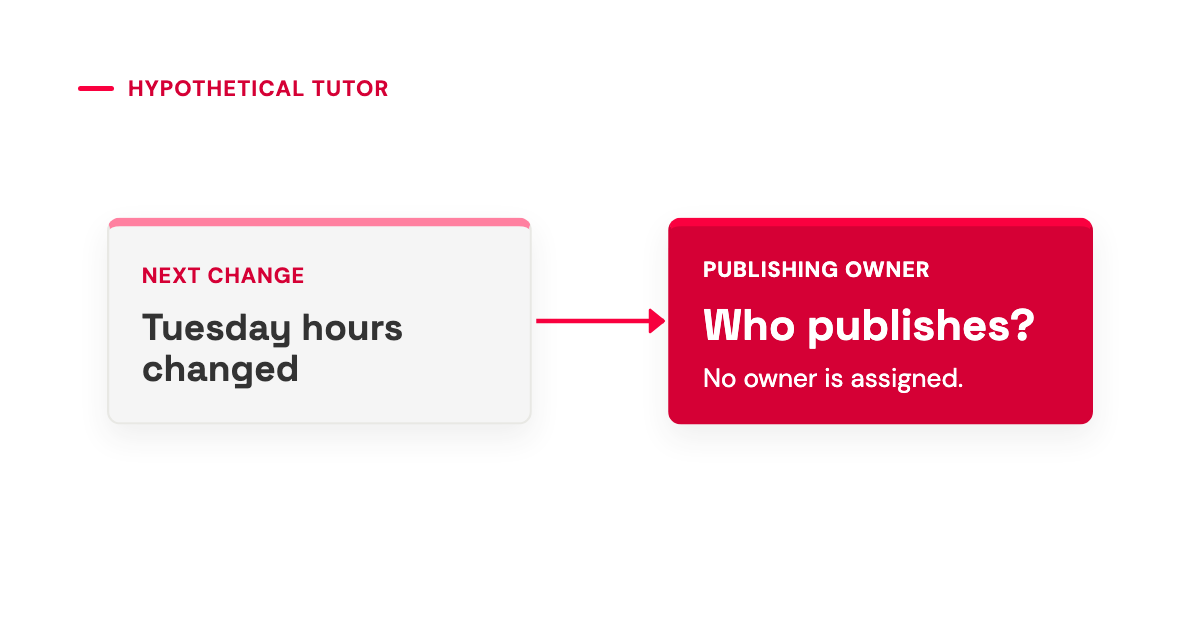
At a glance: Name the editor, list the next three content changes, and list the visitor's next three actions. This is a practical decision aid, not a validated selection formula. Static/dynamic describes delivery; a CMS or builder needs an editing workflow you can actually use. Public information with a dependable publisher may be enough. Confirmed booking state or private student records calls for a separate interaction decision, not an automatic custom build.
Write the visitor's job before naming a site model
The Australian government guide on setting up a business website starts with goals, before choosing hosting or a CMS, and includes maintenance after launch.[3] That sequence is useful here as planning guidance, not a platform endorsement or a legal requirement for every market.
For the hypothetical tutor, a prospective student or parent should be able to check whether the lessons fit, find current hours, and ask a question. Write those actions down before discussing how the page will be built.
The public information supporting them could be:
- What the tutor teaches, including the class or lesson description.
- Where the service operates and which area it serves.
- Current lesson hours or schedule information.
- A few accurate photos, with enough context to understand what they show.
- A clear route for making an inquiry.
This is an illustrative brief, not an industry minimum. A different local service might need different information. The useful constraint is that each item has a visitor job, rather than being included because a template has a space for it.
Keep the last action precise. “Ask about Tuesday lessons” and “reserve an available Tuesday lesson and receive confirmation” are different requests. For this initial brief, the visitor sends an inquiry; the tutor responds separately. No confirmed reservation has been promised.
With that distinction written down, “we need a website” becomes a bounded job. Now the labels can help describe the setup instead of deciding the job for you.
Static website vs website builder: separate delivery from editing
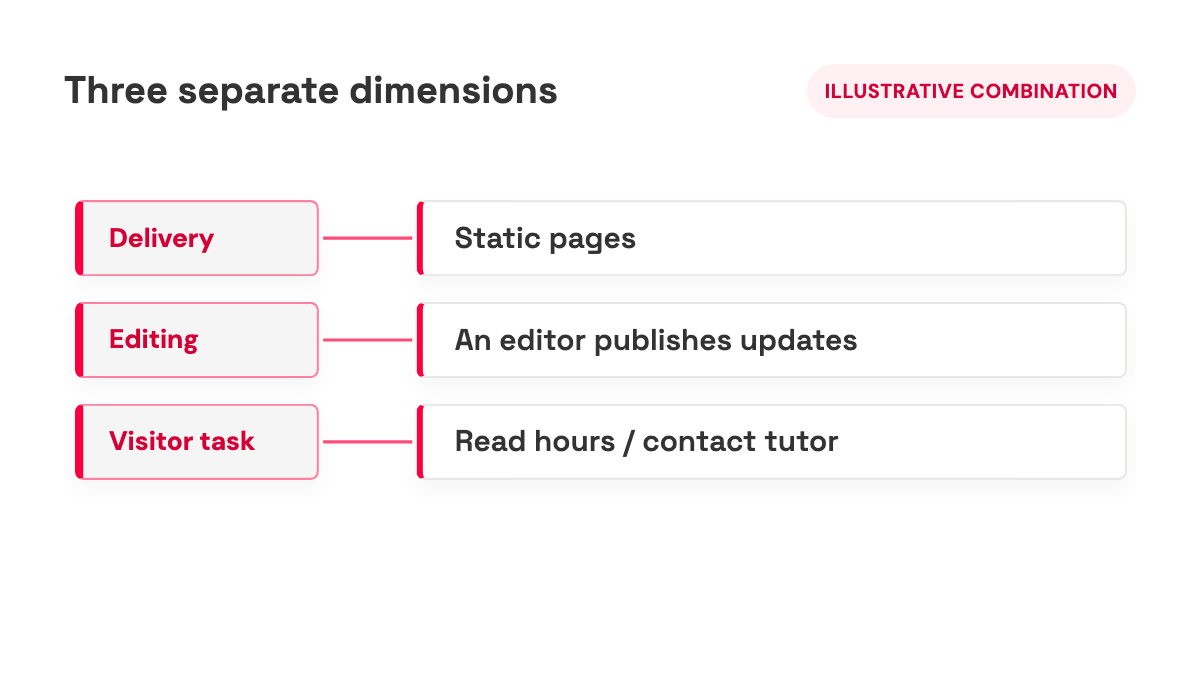
MDN's static/dynamic distinction concerns what happens when a resource is requested. Static delivery returns fixed content; dynamic responses can use database data or vary with user-provided information.[1] A CMS, by contrast, is software for publishing, organizing, changing, or removing content.[2]
Those are separate dimensions. Changing the hypothetical tutor's public Tuesday-hours page is a content edit. Showing a signed-in student only their own lesson history is visitor-specific behavior. Calling both “a site that changes” hides the difference.
| Label | Question it helps answer | What the label alone does not settle |
|---|---|---|
| Static/dynamic delivery | Is the requested content fixed or generated using data or visitor information? | Who can publish a corrected schedule. |
| Website builder | Which site-creation and editing tool is being considered? | Whether its actual editing and visitor workflows meet this brief. |
| CMS | How is content published, organized, and changed? | Whether delivery is static or dynamic, or what bookings require. |
| Custom app | Which specific visitor workflow might need custom application work? | Whether an existing service already handles that workflow. |
A static page can be changed at its source and republished. The definition describes the response a visitor receives, not a ban on future edits.[1] But that possibility is still short of an operating plan. If only the original developer can make the change, the tutor needs an agreement with that person. If an editing interface is supplied, someone still has to use it.
Name the editor and test the next three changes
A CMS's documented role includes changing content; the government setup guide also makes maintenance part of the website's life.[2][3] Neither tells you who will correct this tutor's Tuesday hours. Put a person against the work.
For our hypothetical tutor, use three sample changes: update Tuesday hours, add a class description, and replace a photo. Three is my suggested test size, not a published standard. It is enough to examine different edits without turning the choice into a full site audit.
For each change, record:
- Who has the correct information.
- Who can publish it.
- What triggers the edit, or when you expect it to happen.
- How the publisher will check the live result.
Take the hours edit. The tutor supplies the new schedule. If a developer will publish it, agree how the correction reaches them and whether that arrangement fits the tutor's need. A rare, planned description change and a time-sensitive hours correction need not have the same handoff. Don't invent a weekly maintenance routine just to fill a checklist.
A plain static site is a reasonable baseline for this modest public brief. If edits are occasional and a dependable publisher is available, I would keep that option. Delegating publication is a legitimate choice; it comes with a dependency on that publisher.
If the tutor needs to make corrections without waiting for someone else, require a demonstrated owner-editable path. In a candidate builder or CMS, ask the intended editor to change sample hours and replace a sample photo, then check the published page. Judge the workflow you saw, rather than assuming the category name guarantees ease. Static delivery can remain a separate decision.
For related guidance on responsibility after publication, see the post-launch owner map.
Once the publisher can correct the hours, ask whether a visitor can reserve one of them.
A booking link and a booking system are different requirements
MDN explains how server-side responses can use database data and user-provided information.[1] That distinction matters when “booking” stops meaning an inquiry and starts meaning a confirmed place in a schedule.
Suppose our hypothetical tutor adds a link to a separate booking service. The public site points visitors elsewhere to finish that task. The next evaluation is whether that service handles the required booking behavior; the link alone does not tell you. This arrangement need not replace the information page.
Now suppose the requirement is that the site itself maintains lesson availability, confirms reservations, and shows each student their private lesson records. A fixed public page by itself does not resolve that job. I would investigate an application-capable setup or an existing service that supplies the behavior. Custom development is an option to evaluate, not the inevitable next rung.
Keep inquiries separate from confirmations. For this example, sending “Is Tuesday available?” leaves a question for the tutor to answer. Receiving a confirmed Tuesday reservation makes a different promise to the visitor. The word booking in a brief is too loose to distinguish them.
A contact form alone does not settle the model either. Its processing depends on the implementation. A login is a prompt to ask what happens after signing in, not proof that every site with an account needs a custom app. Ask for the actual task: reading private lesson history, for example.
The public page and the visitor workflow now have separate requirements. Neither can be chosen by a promised local-search position.
Local visibility cannot supply a site-model winner
Google says local results are mainly based on relevance, distance, and popularity. Its Business Profile guidance also says complete and accurate business information is more likely to show in local results.[4] The page does not compare static sites, website builders, CMSs, and apps.
For the hypothetical tutor, an outdated teaching location or incorrect hours is information to correct. That is a concrete task for the owner. It is not evidence that changing the website's delivery model will move it to the first page of local results.
The reviewed sources do not justify a ranking winner. They also do not establish that all models rank equally or that website technology never matters. Those would be different claims requiring different evidence.
If someone recommends a model because it “will rank first,” ask for evidence of that specific comparison. Google's guidance names factors, not an architecture guarantee; it also says there is no way to request or pay for a better local ranking.[4] Don't translate that into a promise from a site supplier.
I would keep the accurate-information work and reject the unsupported winner. Then return to the requirements the tutor can inspect: the next edit has a publisher, and the visitor's intended action has a clear path. Those are the grounds for this site-model decision.
Choose the smallest setup that passes the tutor's handoff
Return to the hypothetical tutor's complete inventory. The next edits are Tuesday hours, a class description, and a replacement photo. Visitors need to check lesson fit, find current hours, and make an inquiry. The tutor owns the information; who publishes it remains the decision to resolve.
This is an illustrative application of MDN's delivery/editing distinctions and the government guide's goal-first, maintenance-inclusive sequence.[1][2][3] It is not a customer result or a tested selection method.
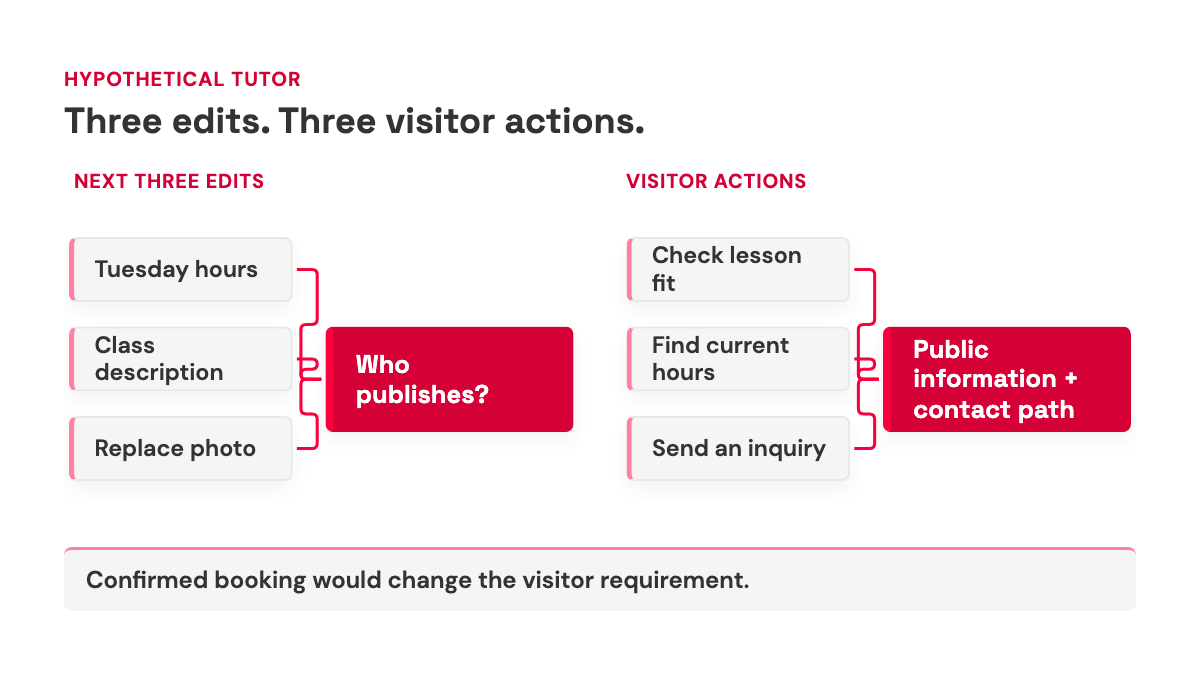
With a dependable publishing handoff, a static information site can be sufficient for this initial job. It suits the public-information brief; it is not sufficient by itself for private records or maintained booking state. Nor is it a workable choice if nobody can carry out the required edits.
If the tutor needs to publish frequent or time-sensitive corrections independently, I would require an editing interface they can demonstrate using. A suitable builder or CMS might already meet that need. There is no reason to prolong the decision with a taxonomy exercise once the sample edits work and the visitor actions are covered. Check the candidate's actual capabilities rather than assuming every tool in that category qualifies.
If confirmed bookings or private records become part of the brief later, reopen the interaction decision. Evaluate an existing service alongside application-capable alternatives. Keep the public information site if it still does its job; a new visitor requirement does not automatically make every existing page obsolete.
My verdict for the initial tutor brief: do not commission a custom app merely to keep hours current.
Keep the site modest and insist on a publishable edit handoff. The least complicated arrangement is the one this owner can operate, including any person they depend on.
The exercise does not choose a supplier, budget, hosting plan, migration strategy, or ranking outcome. It gives whoever will build or maintain the site a concrete brief. A few terminology questions remain before handing it over.
Questions that remain after choosing the requirements
Can a static site still be edited?
Yes. MDN's definition concerns fixed content returned for a requested resource; its CMS definition concerns managing content.[1][2] Changing source content and republishing is different from generating a visitor-specific response. For the hypothetical tutor's hours, you still need to establish who can make and publish that correction.
Does wanting fresh hours mean I need an app?
I would not treat a public Tuesday-hours correction as an application requirement. It asks for an editing and publishing path. That is different from showing one signed-in student their private lesson history. Start by testing the correction workflow; investigate application behavior when the visitor's actual task calls for it.
Does a booking request mean custom development?
Not automatically. Separate an inquiry, a link to another booking service, and a site maintaining reservation state. MDN documents responses using stored data or user information.[1] My decision advice is to evaluate the required behavior, including existing services, rather than use the word “booking” as an instruction to commission custom work.
For a small business, the static website vs website builder choice still comes down to this: when Tuesday's hours change, who can put the correct hours on the live page? Send this three-change test to whoever will publish your next site update.
References
- MDN Web Docs, “Introduction to the server side.” Explains static requested-resource responses and dynamic responses using database data or user-provided information. https://developer.mozilla.org/en-US/docs/Learn_web_development/Extensions/Server-side/First_steps/Introduction
- MDN Web Docs, “CMS.” Defines software for publishing, organizing, changing, or removing content. https://developer.mozilla.org/en-US/docs/Glossary/CMS
- business.gov.au, “Set up a business website.” Australian government planning guidance starts with goals and includes maintenance and monitoring after launch; it does not endorse a site model for this scenario. https://business.gov.au/online-and-digital/business-website/set-up-a-business-website
- Google Business Profile Help, “Tips to improve your local ranking on Google.” Gives Google's published local-ranking guidance; it does not compare static sites, builders, CMSs, and apps. https://support.google.com/business/answer/7091?hl=en