The Three Ways AI-Generated Pages Drift Off-Brand (and a Brand Consistency Checklist)
Font drift, color drift, voice drift: AI page generators cause all three because they re-interpret your brand on every generation. Here is the design token system that fixes it, and a seven-point checklist to run before your next batch publishes.
You're reviewing the fourth landing page in a campaign batch. The first three looked fine when you approved them. This one looks fine too, technically. But something is off. The button is the right color, roughly. The heading font is your heading font, approximately. The copy reads like your brand, sort of.
That feeling of "almost right" accumulating across a batch is not a QA failure or a one-off error. It is the leading brand consistency problem in AI page generation, and it has a specific name: brand drift. And if you have adopted AI page generation for speed (which, at this point, most marketing teams have), you are already encountering it, even if you have been calling it something else.
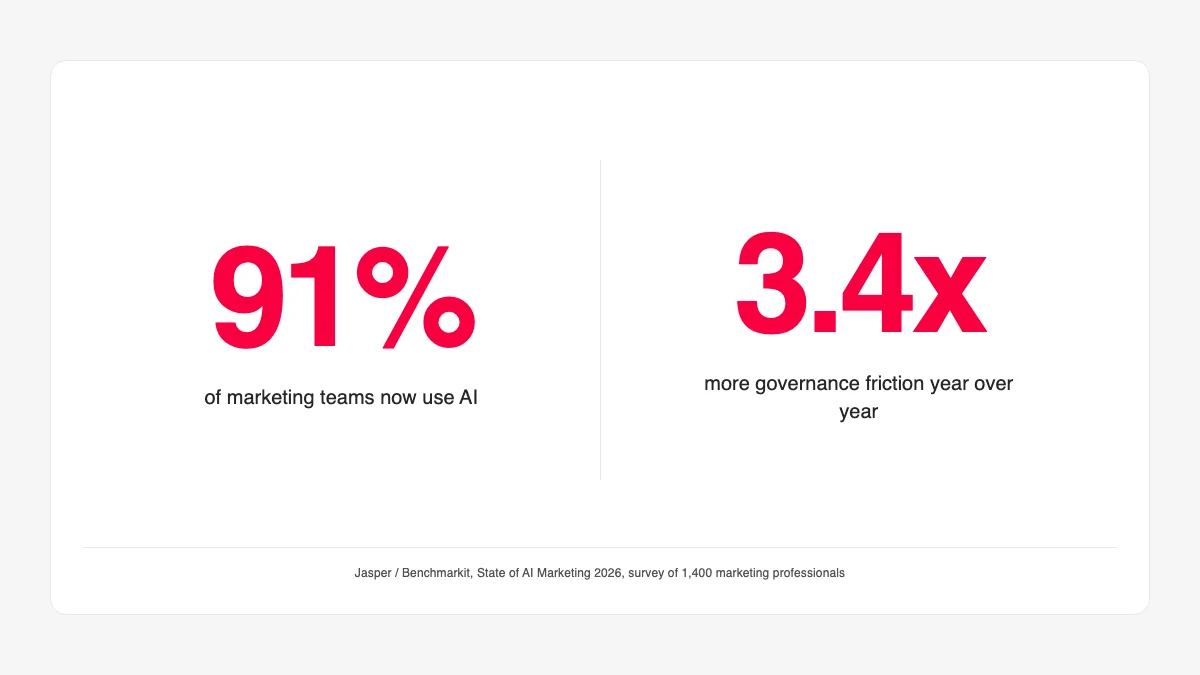
The numbers behind this problem are getting harder to ignore. According to research by Jasper and Benchmarkit surveying 1,400 marketing professionals, 91% of marketing teams now use AI in their work, up from 63% in 2025.[1] More pages, faster. And as content volume has grown, so has the friction: cross-functional review processes around brand governance have increased 3.4x year over year, making governance the leading barrier to scaling AI marketing.[1]
The pages are shipping faster. The brand-review step is getting harder to run. That math produces drift.
If you are already building campaign pages without a designer, you are building at speed. Speed is where drift starts.
This post names the three specific failure modes, explains the structural cause, defines the fix, and gives you a seven-point checklist you can run before the next batch publishes.
The Drift You Are Already Seeing, Just Not Naming
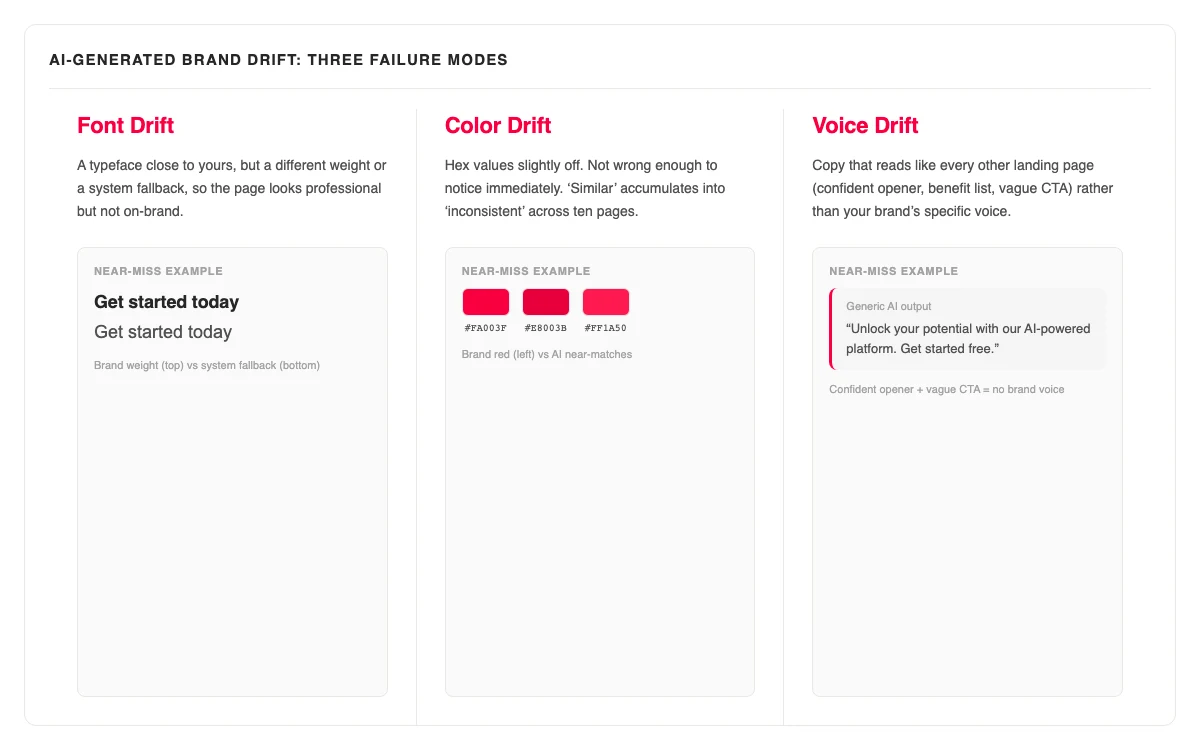
Brand drift in AI-generated pages shows up in three distinct patterns. They happen independently, but they often travel together.
Font drift is when the AI generates a page using a typeface that is close to yours: same category, different weight, or a system-font fallback that the generator substituted because your brand font wasn't in its reference set. The page looks professional. It does not look like your brand.
Color drift is when the hex values are slightly off. Not dramatically wrong. No one picked orange instead of red. Instead, your primary blue has shifted two shades lighter, or your button color is a near-match that the AI inferred from your logo description rather than pulled from a named reference. "Similar" accumulates across ten pages into "inconsistent."
Voice drift is the most common and the hardest to catch. The copy reads like a landing page, because it was generated by a model that has seen thousands of landing pages. It uses the constructs and cadence of that genre (confident opener, benefit list, vague CTA) rather than the specific vocabulary, rhythm, and point of view that belong to your brand. It is grammatically fine. It sounds like everyone else.
All three happen for the same structural reason. Name it and the fix becomes obvious.
The market signal here is significant: Wix's 2025 acquisition of Base44 for approximately $80 million marked one of the larger bets on chat-first, prompt-to-page generation.[3] Base44 builds software through a "fully automated, chat-based interface" from natural language prompts. Wix is not alone in this direction; the entire page-builder category is consolidating around prompt-based generation. More pages are being machine-generated, faster, at a scale small teams could not have reached three years ago.
The volume is the feature. The brand-consistency gap is the tradeoff that comes with it, and "close enough" stops being acceptable once you are shipping twenty campaign pages per quarter instead of four. The mechanism behind all three failure modes is the same, and once you name it, the fix becomes tractable.
Why AI Page Generators Keep Drifting (The Structural Reason)
The drift is not a malfunction. It is what happens by default when the workflow is missing a layer.
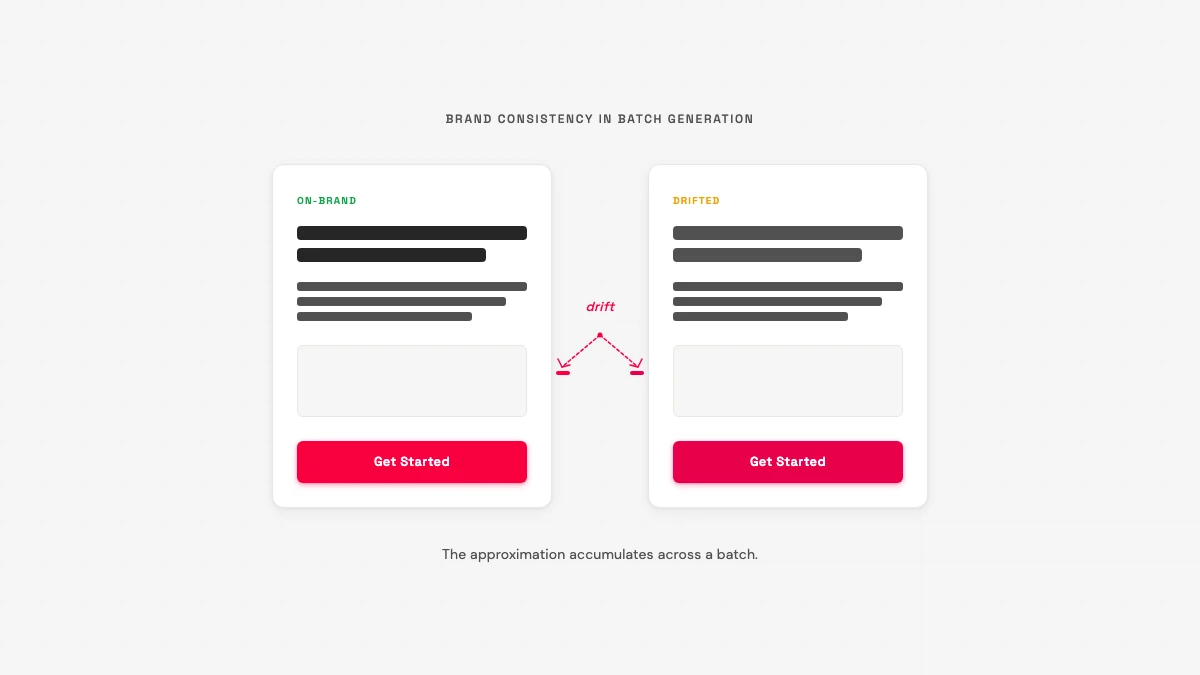
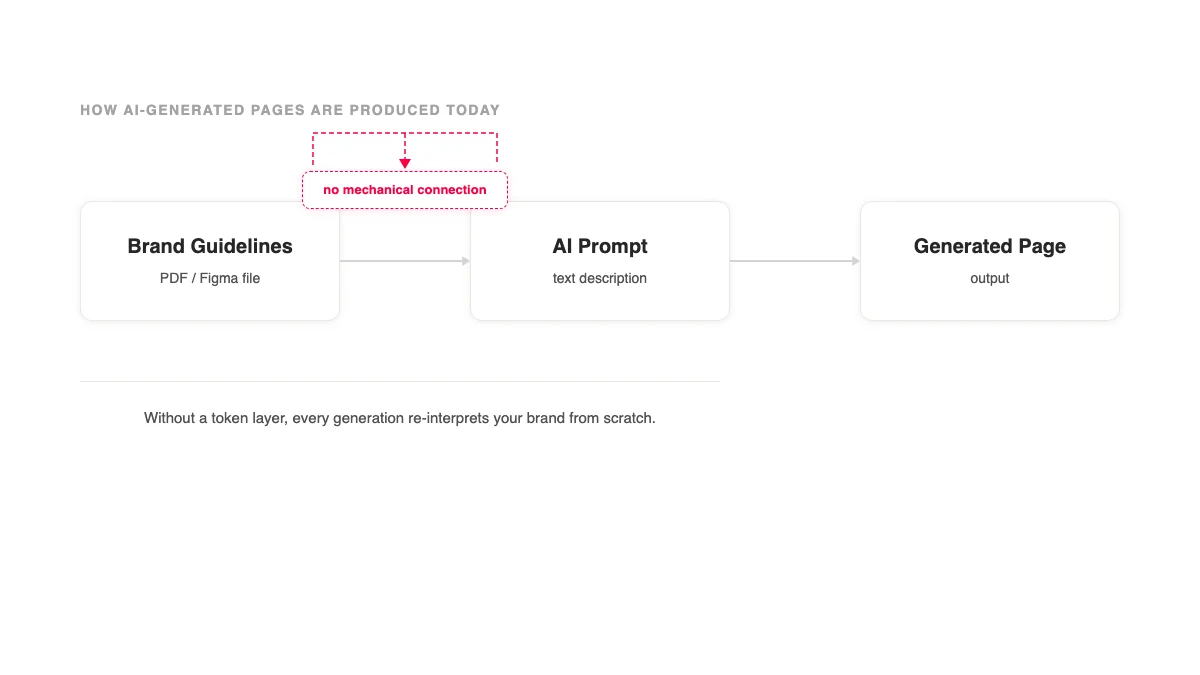
An AI page generator works from what you give it: a prompt, a description, sometimes a URL to reference. Without a connected, authoritative source of what your brand decisions actually are, the generator fills in the gaps from its training data. It has seen a lot of brand-consistent pages; it approximates your brand from the category signals in your prompt. For the first page, the approximation looks good. By the tenth, the accumulated variance is visible.
This is a workflow gap, not a tool failure. As Jasper's own research framing notes, as content volume grows, managing brand consistency and approval cycles grows in complexity, and governance has emerged as the top barrier.[2] The approval cycle gets harder precisely because each generated page was a fresh interpretation, and someone has to check every interpretation by eye.
The structural gap looks like this: your brand guidelines live in a PDF or a Figma file. Your AI generator receives a text prompt. Between "what your brand actually is" and "what the generator produces," there is no mechanical connection. The generator guesses. Sometimes the guess is good. It is never reliable at scale.
Who controls what goes live is the same question at the center of the brand drift problem. If you have worked through what changes when an AI agent is in your content workflow, you have already seen how the approval gate question and the brand-consistency question are really the same question asked from different angles.
The fix is not more careful prompting. The fix is building the layer that was missing: a design token system.
What a Design Token System Actually Does
A design token is a named variable for a single brand decision. Your primary color is not "that blue we use." It is primary-color: #1A3FD8. Your heading typeface is not "the sans-serif we settled on in 2024." It is heading-font: "Space Grotesk", sans-serif. The token names the decision and stores it in a format any tool can consume.
A design token system is the collection of those named decisions, held in one place, structured so that every output (generated page, design file, code component) inherits the same values rather than re-solving the same questions.
The W3C Design Tokens Community Group published the first stable version of the Design Tokens Format Module in October 2025, providing a vendor-neutral standard for how token values are structured and shared across tools.[4] The standard exists because the problem is real and widely shared: design and build tools need a common format to read brand decisions from, rather than each tool maintaining its own interpretation.
In practical terms: instead of each generated page interpreting your brand from your prompt, every output inherits token values that were defined once, by you, in advance. The generator does not guess what shade of blue your primary color is. It reads the token. The guess is taken out of the workflow.
A page that looks slightly off also tends to convert less. The relationship between brand coherence and page performance is direct. If you want to understand how brand perception affects the conversion layer, the structural reasons AI-built pages underperform explains that connection in detail.
Some platforms build this layer in at the template level. Boomlink, for example, applies a design-token layer to its complete website templates, so pages built from a template inherit brand decisions rather than re-interpreting them per prompt. That is the architecture the fix requires, wherever you build. The next question is how a small team actually builds that layer before the next batch ships.
How to Set Up a Token Layer Before Your Next Batch
You do not need a developer to build a working token layer for a small marketing team. You need four decisions and somewhere to write them down.
The Jasper/Benchmarkit data is relevant here: with 91% AI adoption and governance friction at 3.4x year-over-year growth, the review cycles are where time is being lost.[1] A token layer does not eliminate review, but it removes the class of errors that require revision. Pages that inherit the right values from the start need fewer revision cycles.
Step 1: Audit what is already official. Pull the exact hex codes from your live pages using a color picker, not from the slide deck. Note the typeface name and weight from the CSS of your best-performing page, not from a brand guidelines PDF that may be outdated. The token layer should reflect what is actually live, not the aspirational spec.
Step 2: Name the tokens. This step is the system. Assign names to each decision: primary-color, secondary-color, heading-font, body-font, button-radius, primary-cta-verb. The names become the instruction set. A name like "primary-color" is unambiguous in a way that "our blue" is not.
Step 3: Store it somewhere your tools can reach. A shared doc, a Figma variable set, or the settings layer of your AI builder. The medium matters less than the accessibility. If the generator cannot access it, it cannot use it. If the team cannot find it, it will not stay current.
Step 4: Feed the AI the token list, not the PDF. Most AI page builders accept structured style inputs. Reference the token names and values directly: primary-color: #1A3FD8, heading-font: Space Grotesk Bold, rather than prose descriptions like "we use a dark blue and a bold geometric sans." Prose is interpretable. Token values are not.
Step 5: Replace the eye-check with a token comparison. Before the next batch publishes, the review step should compare the generated page against the token list. Not "does this feel right," but "does this hex value match the token?" That question has a binary answer. The eye-check does not.
The Pre-Publish Brand Consistency Checklist
Run this before every batch publishes. Seven checks, each with a binary pass or fail.
1. Font check. Does the heading typeface match the token spec exactly: name, weight, and size scale? Open the generated page next to your best-performing live page. The fonts should be identical, not similar. A font that looks right at a glance may be a different weight at a closer look.
2. Color check. Sample the button color, the primary background, and the accent with a color picker. Do the hex values match your primary-color, secondary-color, and accent-color tokens? "Close" is not a pass. Hex values either match or they do not.
3. Logo and mark check. Is the logo the correct version and lockup? Is the minimum clear space respected? AI generators sometimes pull logo variants from training data rather than from your asset library. Verify against the actual file, not against visual memory.
4. Voice check. Read the headline and first two sentences aloud. Does it sound like your brand, or like a generic landing page? Replace any phrase that you would not have written yourself. If it uses constructs you would edit out of any other piece of copy, edit them out here too.
5. Spacing and layout check. Is the section padding consistent with your other campaign pages? Drift in spacing is the subtlest failure mode and the one that makes "something is off" hardest to name. Compare the generated page against a live reference at the same viewport width.
6. CTA copy check. Does the button copy use your brand's verb convention? "Get started," "Start free," and "Try it now" are not interchangeable. If you have named a CTA verb as a token, it belongs here. If you have not, pick one and write it down.
7. Link and navigation check. Do all links point where they should? AI-generated pages occasionally inherit placeholder links from template training data. Click every link before publish, including the logo and any nav items.
Bookmark this page to reuse before every batch publish.
The Tenth Page Should Match the First
The drift is structural, which means it is also predictable. A generator without access to a source of truth will approximate your brand on every generation. That approximation will vary. The variation will accumulate.
A design token layer makes the fix structural too. You define the decisions once. Every generated page inherits them. The tenth page in a batch is as on-brand as the first not because someone checked it harder, but because the workflow did not give the generator room to drift.
The checklist above is the brand consistency gate. The token layer is what makes that gate fast enough to actually run.
If you would rather inherit that layer than build it, every Boomlink website template ships with its token set already defined, so the brand decisions exist before the first page is generated.
Share this checklist with your team before the next batch ships.
TL;DR: AI page generators produce brand consistency drift because they re-interpret your brand on every generation. The three failure modes are font drift, color drift, and voice drift. A design token system (a single named source of truth for color, typeface, spacing, and copy conventions) is the structural fix. Build the token layer before the batch, then run the seven-point checklist before publish.
References
- Jasper and Benchmarkit, "New Jasper Research Shows AI Is Now Core to Marketing, With Scale and Governance Emerging as Top Barriers" (January 28, 2026). Survey of 1,400 marketing professionals. https://www.prnewswire.com/news-releases/new-jasper-research-shows-ai-is-now-core-to-marketing-with-scale-and-governance-emerging-as-top-barriers-302671894.html
- Jasper Blog, "New Research: The State of AI in Marketing 2026." Narrative framing on governance and brand consistency as the leading blocker to scaling AI content. https://www.jasper.ai/blog/state-of-ai-marketing-2026
- Wix Press Room, "Wix Further Expands into Vibe Coding with Acquisition of Base44" (June 18, 2025). Acquisition of Base44 for approximately $80 million initial consideration. https://www.wix.com/press-room/home/post/wix-further-expands-into-AI code generators-with-acquisition-of-base44-a-hyper-growth-startup-that-simplif
- W3C Design Tokens Community Group, Design Tokens Format Module, first stable version (October 28, 2025). Vendor-neutral standard for sharing design decisions across tools. https://www.designtokens.org/