
Your CMS Has an AI Agent. The Surprising Thing Is How Little Authority It Has.
WordPress and Webflow both gave AI agents write access this quarter. The announcements buried the part that actually matters: the dashboard is still in charge.
Two major CMS platforms gave AI agents write access this quarter. WordPress.com extended its MCP integration from read-only to write, handing agents 19 new capabilities across posts, pages, comments, categories, and media.[1] Webflow relaunched itself as what it calls an "agentic web platform," shipping a closed-loop system that can identify site issues and publish accepted fixes without leaving the product.[3] The announcements landed quickly and got significant coverage.
What they both buried was a detail that matters more than the capability lists: every change the WordPress agent makes defaults to draft and requires explicit human approval before taking effect.[1][4] The Webflow agent prepares recommendations you accept before they go live.[3] Two separate teams, two separate products, the same design choice.
That design choice is not a safety footnote. It is an architectural statement about where authority lives. Understanding it tells you more about how to actually use these tools than any feature list does.
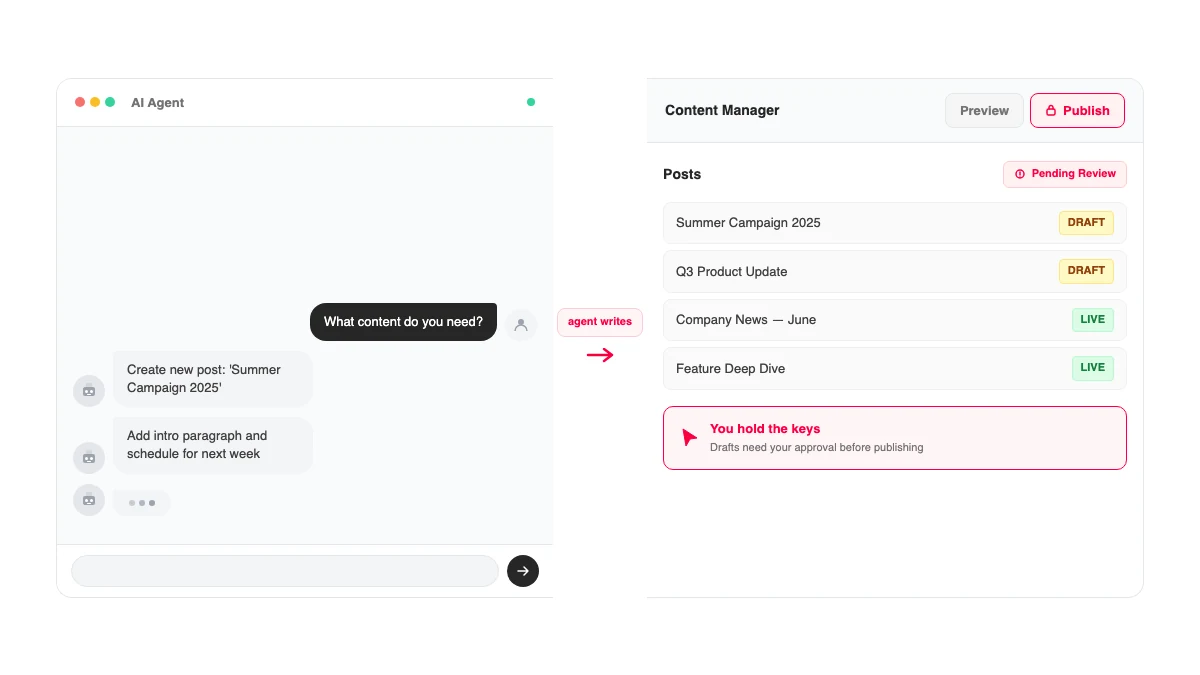
What Each CMS AI Agent Actually Shipped
WordPress.com opened write access through its MCP Adapter, which bridges WordPress Abilities to the Model Context Protocol so AI clients including Claude Desktop, Cursor, and VS Code can discover and execute site functions as MCP tools: fetching data, updating posts, running diagnostics.[2] The write expansion added 19 new abilities across posts, pages, comments, categories, tags, and media. The agent can now create and edit content, not just read it.[1]
Webflow shipped what it calls AEO, an agentic, closed-loop system. The agents surface broken links, outdated schema, missing alt text, and long meta descriptions, then prepare recommendations for those issues and offer direct publishing of accepted changes from within the platform. Webflow describes it as a "closed loop from measurement to recommendation to execution."[3]
Both are real capability expansions. The agents went from reading your site to being able to change it.
Now the shared pattern: WordPress defaults new posts to draft and requires explicit user approval before any change takes effect. Webflow requires you to accept recommendations before they are published. Both systems built the approval gate into the architecture, not as a configurable safety setting but as the default state.
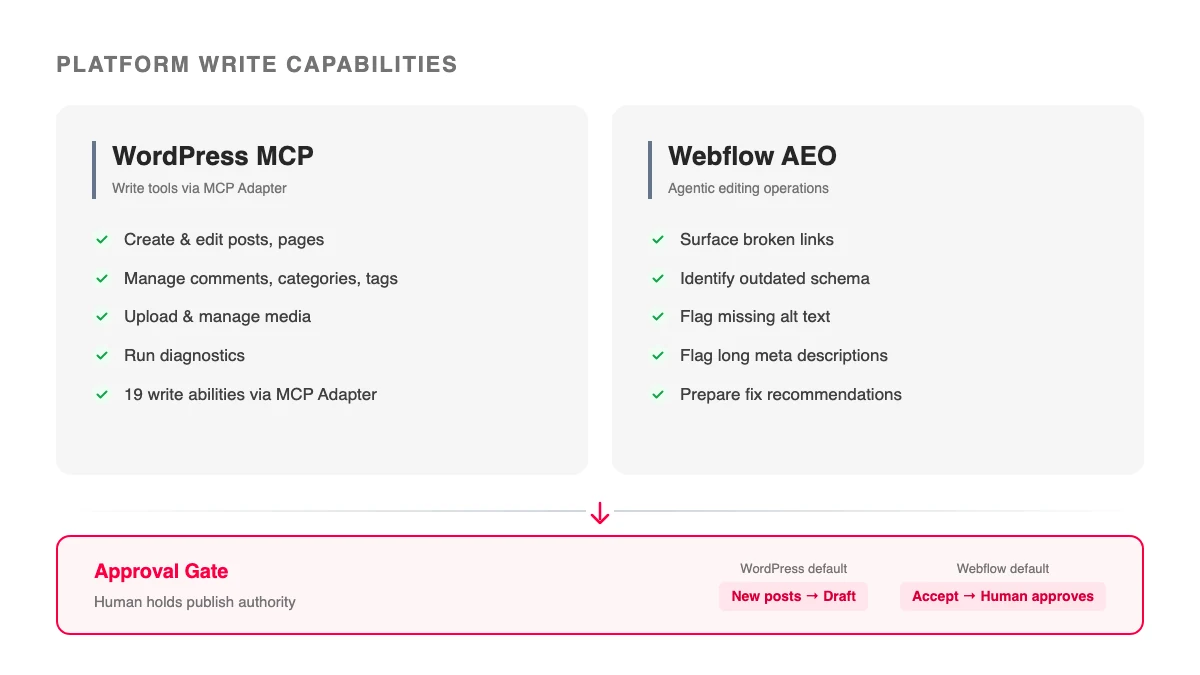
That shared choice is worth sitting with. Two teams, working in different stacks on different use cases, both arrived at the same answer about who holds authority over what is live. That convergence is not a coincidence.
The Trust Question the Announcements Did Not Answer
The announcements generated a lot of "AI can now publish your content" coverage. That framing is technically accurate and practically misleading.
Here is the more precise statement: the agent can generate content and stage it. You publish it. The approval step is still yours, and it did not get smaller.
In WordPress.com's implementation, every change the agent makes requires explicit user approval before taking effect.[4] That sentence is not a cautious way to describe a power feature. It is a description of where the decision authority actually sits. The agent is writing to a content model (posts, pages, draft states, the published/unpublished binary) that pre-exists the conversation. The conversation can create inputs to that model. It cannot override the model's rules.
The draft-default design is an admission of this. When a new post defaults to draft, the CMS is saying: this change has not yet passed through the authority layer. The conversation is upstream of that layer, not the layer itself.
Marketers reading these announcements are stuck on a reasonable question: how much can I trust an agent with publish rights, and what am I still responsible for? The honest answer is that the agent's authority ends at the approval gate. Below that gate, the agent is powerful. At the gate, you are still the decision maker. That boundary is not provisional or temporary. It follows directly from the architecture both platforms chose.
What this means operationally: the marketer's job did not disappear. It compressed. Generating and editing no longer require a human to produce each word. Drafting and staging are faster. The part of the workflow that changed is the front end, where content gets created. The approval step (where a human judges whether something is ready to be live) did not change. It may actually require more focus now, because inputs arrive at that step faster and at higher volume.
The agent expanded from read to write. The marketer's responsibility contracted to a narrower, higher-stakes task: approving, not generating. That boundary makes sense inside a retrofit. It also shows you where the retrofit assumption lives.
The Retrofit Assumption and What It Costs
Here is the architectural distinction the announcements do not explain, and that the how-to setup guides skip entirely.
In a retrofit, the CMS was built before the agent existed. The pages, draft states, publish steps, and approval gates are a content model that predates the conversation. The agent is given write access to that model. It can send instructions. The model's rules are still the authority.
This is where both WordPress and Webflow sit. That is not a criticism. The retrofit pattern is a practical response to the install base. Hundreds of millions of sites run on WordPress. Retrofitting MCP write access onto that infrastructure meets users where they already are, which is the right call at that scale.
But the retrofit assumption is worth naming because it decides how much any of this changes your workflow. If the CMS is the authority and the agent is a faster intake mechanism, your workflow changes in speed, not in structure. You still have the same model of pages, drafts, publish states, and approval gates. The agent fills the top of that funnel faster. The funnel itself did not move.
The WordPress MCP Adapter architecture makes this explicit: it is a bridge from the existing WordPress Abilities system to the Model Context Protocol, so agents can reach through to functions the CMS already had.[2] The bridge is well-built. It is still a bridge to a system with pre-existing rules.
The alternative pattern is different in kind, not just degree. Instead of a content model with an agent bolted on, the deliverable is a real, working website with its own built-in database, built from durable templates and a ready-made part system, with the AI editing only a wording and layout layer. There is no CMS sitting behind it waiting to receive instructions, because the unit of value was never managed content. Why we didn't build a CMS at all is the design argument behind that choice, and it is worth reading if the architectural question interests you beyond this particular announcement cycle.
WorkOS described the industry direction this year as moving "from apps with AI to AI with apps," with conversation becoming the layer that sits in front of existing applications.[5] That framing is accurate for the retrofit path. It also still describes a world where the app is the thing being wrapped. The complete-app path does not wrap anything; it ships the application itself, with its own data.
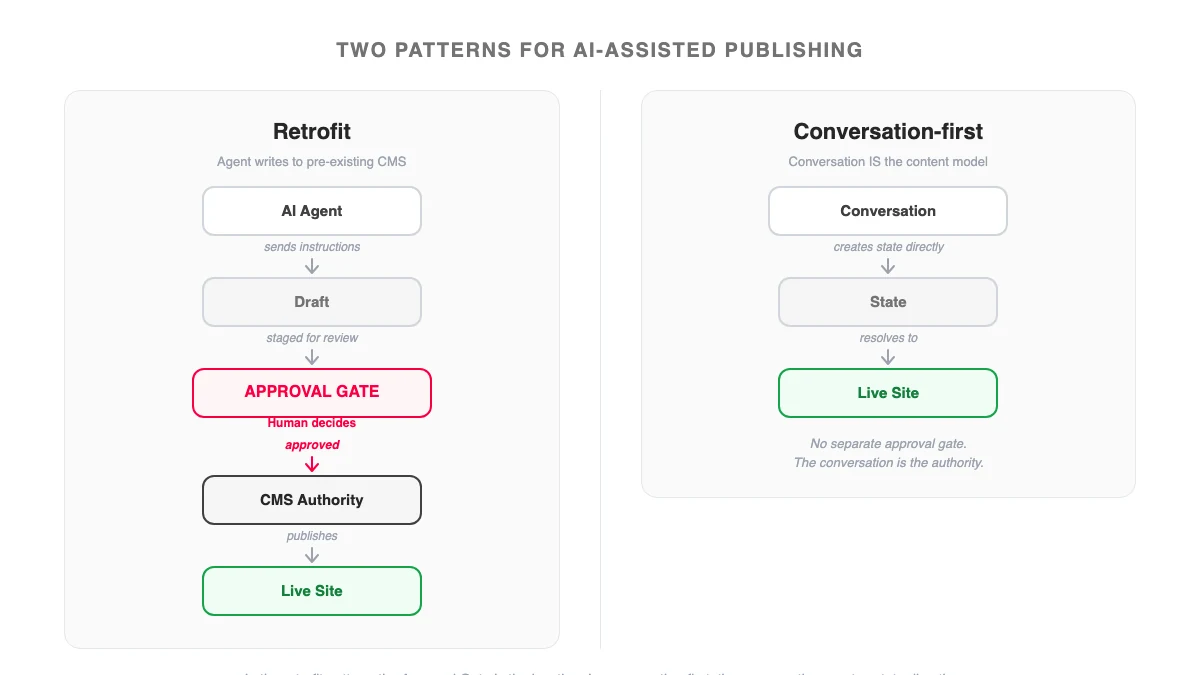
For marketers evaluating platforms, the meaningful architectural question is not whether the platform ships an AI agent. Both WordPress and Webflow have one now. The question is where the agent's authority ends and the marketer's begins, and whether that boundary is a design choice or a safety default that has not been removed yet. Those are different situations with different implications for what you can delegate and what stays with you.
What Actually Changes in Your Workflow
Drafting is faster. Agents can generate, edit, and stage content without a human writing each word. For anyone managing high editorial volume, that is a genuine productivity shift. The time from "I need a post about X" to "here is a staged draft" collapses significantly.
Diagnostics improve. Webflow AEO agents surface broken links, outdated schema, missing alt text, and long meta descriptions automatically and pair them with proposed fixes inside the same platform.[3] Finding those issues used to mean manual audits or dedicated third-party tools. That work is now faster and more systematic.
The feedback loop between content intent and published result is shorter. Less waiting on a production step that requires someone else to act.
Here is what does not change.
You still approve. Every change the agent stages, you review. That responsibility did not transfer. The judgment call about whether something is ready to be live is yours, and it matters more now, not less, because the drafts arrive faster and volume scales.
Tone, context, and brand judgment are still yours. The agent has access to your content model. It does not have access to your understanding of why a particular page should say what it says to this particular audience at this particular moment. Understanding why a page stops converting requires that kind of audience context, not faster content generation.
Publishing without a production bottleneck is now a more realistic outcome for teams managing high-volume sites. The approval bottleneck did not move.
The framing "AI agents have the publish button" is accurate but incomplete. The more precise read: your CMS now has a faster intake mechanism with the same approval model it always had. The agent is real, the capability is real, and the authority structure has not moved.
If you are evaluating where to put your site next, the question worth asking is not whether the platform ships an AI agent. It is whether the agent is a layer on top of an existing content model or whether it is the model. Those are different bets, and the platforms that shipped agents this quarter are squarely in the first category.
The second pattern looks different by design. Read the design argument behind it: We Didn't Build a CMS. We Built Complete Apps. For the product-level version of that answer, what is Boomlink sets out where the agent sits relative to the content model.
References
- WordPress.com Blog, "AI agents can now create and manage content on WordPress.com" (published 2026-03-20, updated 2026-05-15). 19 new writing abilities across posts, pages, comments, categories, tags, and media; new posts default to draft with explicit human approval required before changes take effect. https://wordpress.com/blog/2026/03/20/ai-agent-manage-content/
- WordPress Developer Blog, "From Abilities to AI Agents: Introducing the WordPress MCP Adapter" (published 2026-02-04). The MCP Adapter bridges WordPress Abilities to the Model Context Protocol so AI clients can discover and execute site functionality as MCP tools. Primary architecture source. https://developer.wordpress.org/news/2026/02/from-abilities-to-ai-agents-introducing-the-wordpress-mcp-adapter/
- Webflow Blog, "Introducing Webflow AEO: an agentic, closed-loop system for AI discovery" (published 2026-05-20). Agents identify site issues, prepare recommendations, and enable direct publishing of accepted changes. Vendor description: "closed loop from measurement to recommendation to execution." Enterprise-only at launch. https://webflow.com/blog/introducing-webflow-aeo
- TechCrunch, "WordPress.com now lets AI agents write and publish posts, and more" (published 2026-03-20). Independent-outlet corroboration that WordPress.com extended MCP from read to write; every change requires user approval, posts default to draft. https://techcrunch.com/2026/03/20/wordpress-com-now-lets-ai-agents-write-and-publish-posts-and-more/
- WorkOS Blog, "The shift from apps with AI to AI with apps" (2026). Strategic framing: the industry is moving from "apps with AI" to "AI with apps," with conversation becoming the layer in front of existing applications. Attribution: WorkOS; strategic claims are opinion, not independently verified. https://workos.com/blog/building-mcp-apps-inside-claude-chatgpt