Your Landing Page Assumes a Skeptic. The AI-Referred Visitor Is Not One.
AI-referred visitors converted 31% more and generated 254% more revenue per visit during holiday 2025. That behavioral gap is real and it has a specific implication for page design.
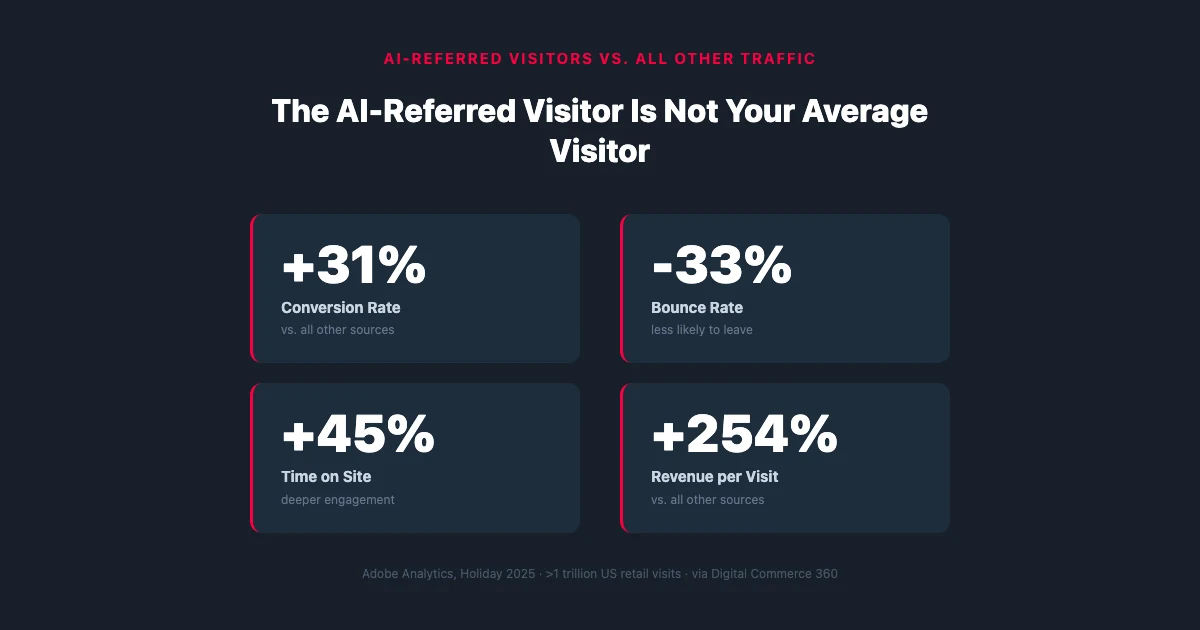
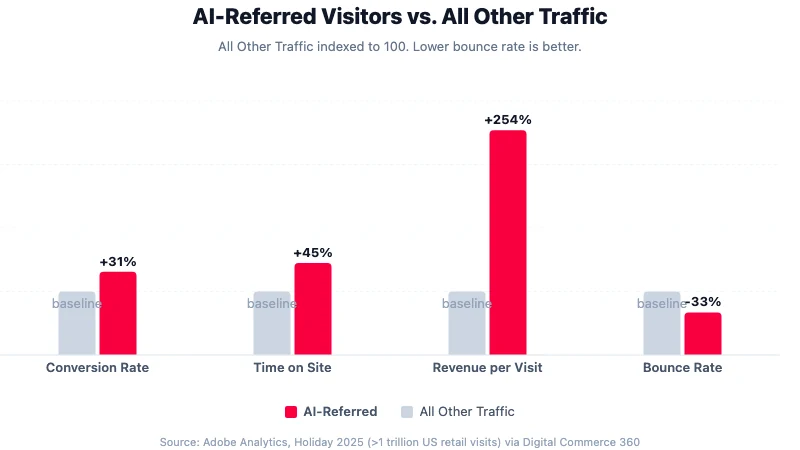
During holiday 2025, visitors who arrived at US retail sites via generative AI converted 31% more than visitors from other sources. They bounced 33% less. They spent 45% more time on site. They generated 254% more revenue per visit. Adobe Analytics measured this across more than one trillion visits to US retail sites, covering 100 million SKUs across 18 categories.[1]
None of that lift is explained by the offer or the page. The products were the same. The pages were the same. The difference was the visitor.
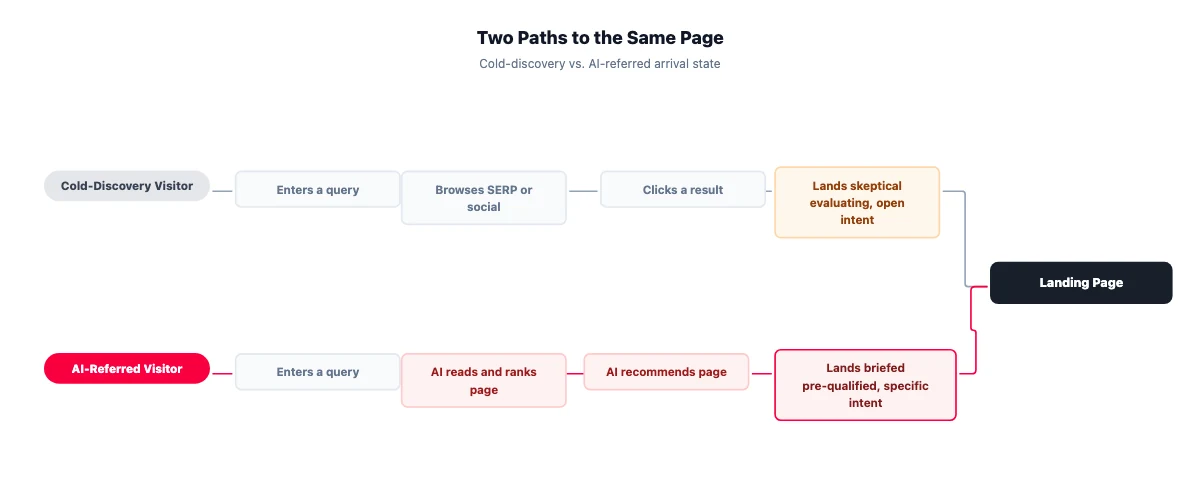
The AI-referred visitor arrives after a recommendation engine has already screened them, read the page (or the broader web), and decided they were a match. That's a structurally different arrival state from cold discovery. A visitor who found the page through a keyword search or a social scroll is still evaluating: Do I trust this? Is this what I needed? Should I keep reading? A visitor who arrived because an AI assistant recommended the page has already cleared most of those questions. They came for something specific.
Most landing page guidance assumes the opposite visitor. The default patterns, long trust sequences, category-level awareness copy, persuasion runway before the ask, were built for someone meeting the product for the first time and possibly skeptical about it. Those patterns aren't wrong for cold traffic. They're just not calibrated for the visitor who's increasingly arriving alongside it.
This piece walks the 2025-2026 behavioral data and then names four design priorities that follow logically from how AI-referred visitors actually behave. Every priority is labeled as inference from the data, not proven causation. That distinction matters and it runs through everything below.
What the Data Shows, and What It Doesn't
The Adobe Analytics figures above come from holiday 2025 retail data reported by Digital Commerce 360.[1] They're worth restating with the units that make them concrete: compared to other traffic sources, AI-referred visitors converted at a rate 31% higher, generated 254% more revenue per visit, bounced 33% less, spent 45% more time on site, and viewed 13% more pages per visit. Generative AI retail traffic grew 693% year-over-year across the holiday season overall, with November up 769% and December up 673%. The dataset covers more than one trillion US retail visits across a two-month window.
Salesforce data from the first half of 2025, reported by Tatvic, frames the conversion premium differently: AI-referred traffic converted at rates 700% higher than traffic referred from social media in H1 2025.[2] That figure is Salesforce's own measurement as reported by a third party, not a controlled trial. The Adobe and Salesforce data sets aren't directly comparable, but they point in the same direction with enough consistency to take seriously.
McKinsey's research on agentic AI in marketing projects that roughly 44% of consumers now use AI as their primary search tool, with AI agents expected to mediate between $3 and $5 trillion in global commerce by 2030.[3] Those are consulting projections, not measured facts. They signal the scale of the shift but shouldn't be cited alongside the Adobe figures as equivalent evidence.
What the data doesn't show: it doesn't identify which page design decisions produced the lift. The Adobe dataset measured visitor behavior across existing pages, not page variables held constant across two audience cohorts. There's no controlled experiment here. The conversion premium belongs to the visitor type. Everything in the four priorities below is reasoned inference from the behavioral evidence, not a prescription with proven causal links.
Why This Visitor Arrives Differently
Tatvic's framework for thinking about AI-referred traffic separates the problem into two jobs.[2]
Job 1: Convert the human who arrives. Most brands are doing this reasonably well.
Job 2: Be clear, trustworthy, and recommendable to the AI that decides to send them. Most brands aren't doing this at all.
The distinction matters for page design because it names a new actor in the referral chain. A visitor who arrived from a Google search result clicked a link that appeared because the page ranked for a query. A visitor who arrived from an AI assistant was actively selected by a system that read the page content, weighed it against the query, and made a recommendation. The human didn't browse to the page. They were directed to it.
That arrival state is different in a specific way: the visitor comes briefed. The AI assistant read the page (or what it knows about the page), matched content to the query, and effectively said: this is the thing you're looking for. The visitor arrives with a specific expectation already in place. They're not in an open-ended search posture.
McKinsey's figures suggest this is no longer a niche channel.[3] If roughly half of consumers are now using AI when they search, AI-referred visitors are arriving alongside cold-discovery visitors in the same sessions, on the same pages, in proportions that will make it harder to ignore.
Where the Cold-Traffic Playbook Works Against You
Most landing page best practices were developed for the cold-discovery visitor. They're not wrong for that audience. The problem is they're applied to pages where AI-referred traffic is now a meaningful segment, without any adjustment for the different arrival state.
Three patterns show up consistently, and each creates friction for a pre-qualified visitor in a specific way:
Long trust-building sequences above the fold. A five-module credibility stack before the value claim makes sense when the visitor needs to believe the source before they'll read the claim. AI-referred visitors have already been recommended by a source they extended trust to. The page asking them to rebuild that trust from zero is asking them to do something they've already done. The sequence isn't wrong; the placement may be.
Awareness-level copy. "The easiest way to manage your [category]" is written for a visitor who's still deciding whether the category applies to them. AI-referred visitors often arrive because the AI matched a specific claim to a specific need. Category-level framing at the top of the page can feel like being redirected to a lobby after you've already confirmed your room number.
Persuasion runway before the ask. The -33% bounce rate in the behavioral data suggests AI-referred visitors don't leave quickly. The +45% time on site suggests they read. The question is whether what they're reading matches the specific thing the AI told them they'd find. A long scroll-to-CTA path calibrated for gradually building interest may be solving for a hesitation that's not there, while leaving unaddressed the more relevant question: does this match what I heard?
This isn't an argument for shorter pages or less proof. The argument is narrower: the sequence and framing of existing elements may be calibrated for the wrong visitor. Proof that says "trust us, we're legitimate" and proof that says "yes, this is exactly what you heard about" are different objects. Pages that serve AI-referred visitors well need both. The question is which one leads. That distinction also connects to brand consistency: pages that drift off-brand also drift out of AI recommendation pools.
Four Design Priorities for the AI-Referred Visitor
These priorities follow from the behavioral data and the structural reframe above. Each one is inference, derived from what the data shows about how AI-referred visitors behave, not from a controlled test of any specific design choice.
1. Surface the claim the AI matched on
The recommendation engine matched the visitor's query to something specific on the page or in how the page is described on the web. There's a specific claim, a use case, a feature, an outcome, that triggered the referral. If that claim is buried in the fourth section after the brand story and the feature grid, the visitor who arrived specifically for it has to go looking.
This priority is about legibility on arrival, not about adding anything new. It's about making sure the thing that earned the referral is the thing the visitor sees first.
2. Reduce friction for a visitor who has already decided
The -33% bounce rate and +31% conversion premium together suggest AI-referred visitors arrive further along the decision path than cold-discovery visitors. Friction that was appropriate for a "maybe I'm interested" visitor, multi-step forms, required account creation before any value is delivered, long pre-CTA sequences, may cost more for this visitor type.
The page job shifts. Instead of persuading, it's confirming and capturing. Shorter paths to the ask and specific (not vague) capture steps match the state of someone who arrived to act, not to browse.
3. Shift proof from credibility to confirmation
Cold-discovery visitors need proof that the company exists, that others have used it, and that the problem being solved is real. AI-referred visitors are checking something different: does this match what I heard?
The proof that does the most work here is specific and detail-level, not aggregate and generic. Exact numbers. Specific customer outcomes. Concrete product behavior with enough particularity that a visitor checking for confirmation can actually confirm. Named and detailed outperforms a logo wall or a star-rating average, especially for a visitor who arrived looking for a specific answer to a specific question.
4. CTA specificity over persuasion length
An AI-referred visitor who converts doesn't need a long runway. The +254% revenue per visit figure likely reflects that the visitors who convert are converting with higher intent, not just more easily. A CTA that names the specific next step rather than defaulting to "learn more" or "get started" matches that state better. They arrived for something specific. The CTA should be specific about what they get next.
For the structural conversion decisions that apply across all traffic types, the principles overlap: specific promise, minimum friction, proof before the ask. What changes for AI-referred visitors is the framing and sequencing of each, not the presence of it.
What This Data Doesn't Resolve
The behavioral delta is large enough to take seriously. But several things can't be derived from the current evidence.
The conversion lift belongs to the visitor type, not to any design choice. No version test was run on the pages in the Adobe dataset. There's no way to attribute the +31% conversion rate to a specific page pattern, or to promise that adding confirmation-type proof above the fold will replicate the premium for your page and audience. The data describes how AI-referred visitors behave. What to do about it is still inference.
The Adobe data is from US holiday-season retail. Transfer to SaaS, B2B, or subscription products is a plausible hypothesis. Some of the same mechanisms, briefed arrival state, higher purchase intent, longer session engagement, likely apply in other categories. But the specific magnitudes won't carry over unchanged. Products with long consideration cycles, complex buying committees, or low brand familiarity may show a different pattern.
The "what the AI matched on" assumption in Priority 1 isn't always verifiable. Without query data or referral parameters tagged to specific AI sources, most practitioners are making an educated inference about what triggered the referral. Segmenting AI-referred traffic by referral domain when possible, and tagging sessions where the referral source is identifiable, gives the inference more to work with over time.
What to do instead of assuming: segment first. Pull AI-referred traffic as its own cohort in your analytics. Compare bounce rate, time on site, and conversion against your other organic and paid channels. If the behavioral pattern holds for your audience and product, the four priorities above are a reasonable starting framework. If the numbers look different for your product, the data will tell you something more useful than the framework.
| Priority | What it addresses | Labeled as |
|---|---|---|
| Surface the matched claim | Legibility on arrival for a briefed visitor | Inference from behavioral data |
| Reduce decision friction | Conversion path fit for a decided visitor | Inference from -33% bounce / +31% conversion |
| Shift proof to confirmation | Type of proof that serves a checking visitor | Inference from behavioral data |
| CTA specificity | Next-step clarity for a high-intent visitor | Inference from +254% revenue per visit |
The page that converts well for a cold-discovery visitor and the page that converts well for an AI-referred visitor are not the same page. For most products, the two visitor types are arriving in the same sessions, on the same URLs, on pages designed for one of them.
The behavioral gap is large enough to measure against a baseline. The traffic is recent enough that most pages haven't been redesigned with this visitor type in mind. That's a gap worth closing now, while the patterns are still new enough to study against a clear before-state.
Build and test your page for the AI-referred visitors already in your analytics. If you need a live page before you can run any of this, building one without a designer is the practical starting point, and AI search visibility for startups covers the crawl and markup side of getting cited in the first place. Boomlink lets practitioners make the specificity, friction, and proof-sequencing decisions above without waiting on a dev queue, which matters when the measurement window for this traffic type is still narrow enough to learn from.
References
- Adobe Analytics holiday 2025 retail data, reported by Digital Commerce 360 (January 13, 2026). Dataset: more than 1 trillion US retail visits, 100 million SKUs, 18 product categories. AI-referred visitors: conversion rate +31% vs. other sources; bounce rate -33%; time on site +45%; revenue per visit +254%; pages per visit +13%. Overall generative-AI retail traffic: +693% YoY (November +769%, December +673%). Adobe is the first-party measurement source; Digital Commerce 360 is the reporting outlet. https://www.digitalcommerce360.com/2026/01/13/generative-ai-online-holiday-shopping-traffic-2025/
- Tatvic, "Landing Page Optimization for AI Ecommerce 2026" (published May 1, 2026). Source of the Job 1 / Job 2 framing and the Salesforce H1-2025 figure: conversion rates from AI channels 700% higher than social media traffic in the first half of 2025. Salesforce is the primary source behind the H1 figure; Tatvic is the reporting outlet. https://www.tatvic.com/blog/landing-page-optimization-ai-ecommerce-2026/
- McKinsey, "Reinventing marketing workflows with agentic AI" (2026). Source of the approximately 44% primary-search figure and the $3-5 trillion agent-mediated commerce by 2030 projection. These are consulting projections and consumer survey findings, not independently verified measurements; use as directional context. https://www.mckinsey.com/capabilities/growth-marketing-and-sales/our-insights/reinventing-marketing-workflows-with-agentic-ai