
Your AI Website Builder Is Being Renamed. Generator, Workspace, or Operator?
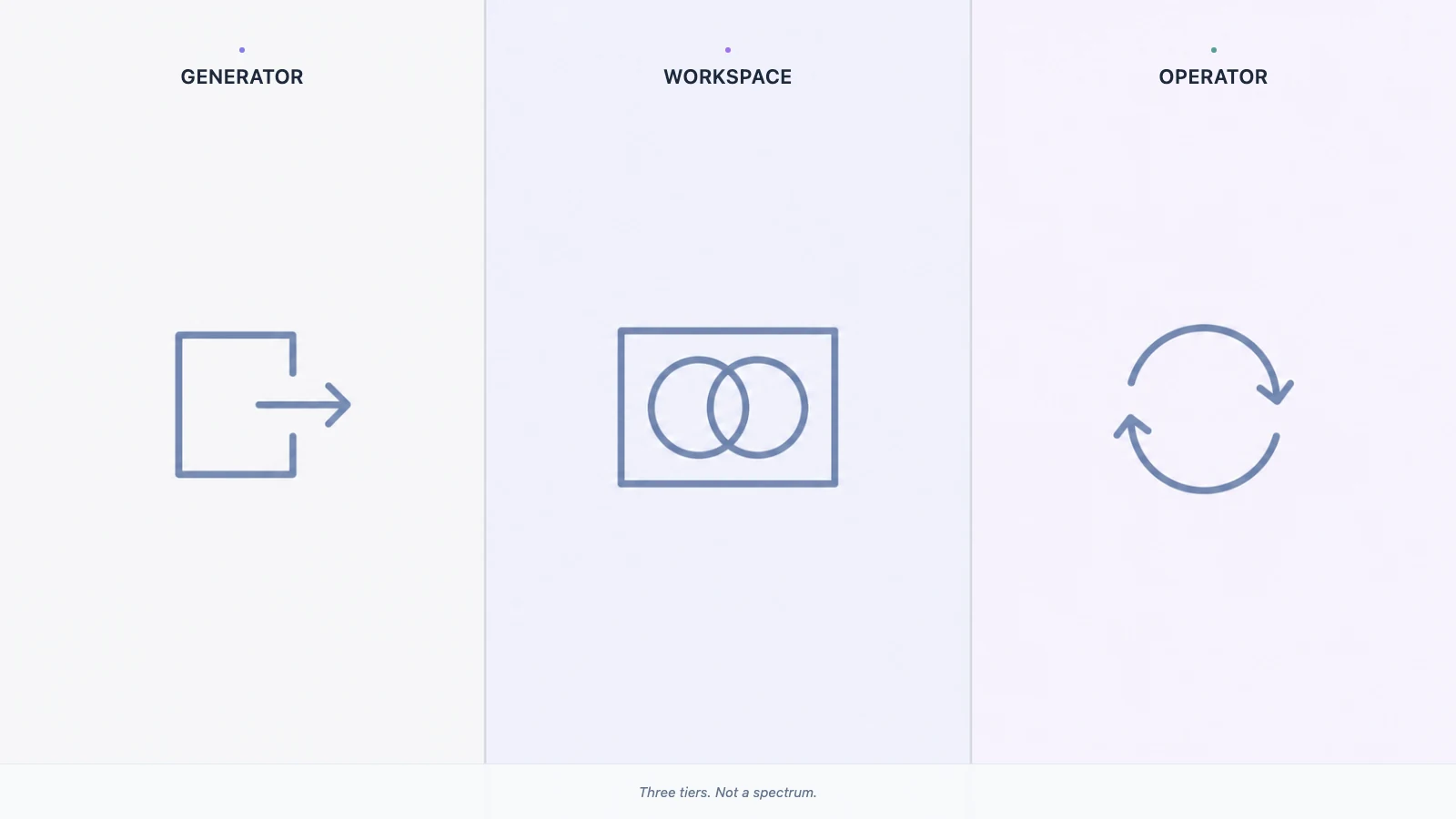
The category is splitting. Generator, workspace, and operator are not marketing tiers. They describe what the tool does with the work after the agent runs.
In six weeks, two of the largest website platforms repositioned themselves around the same word: agents.
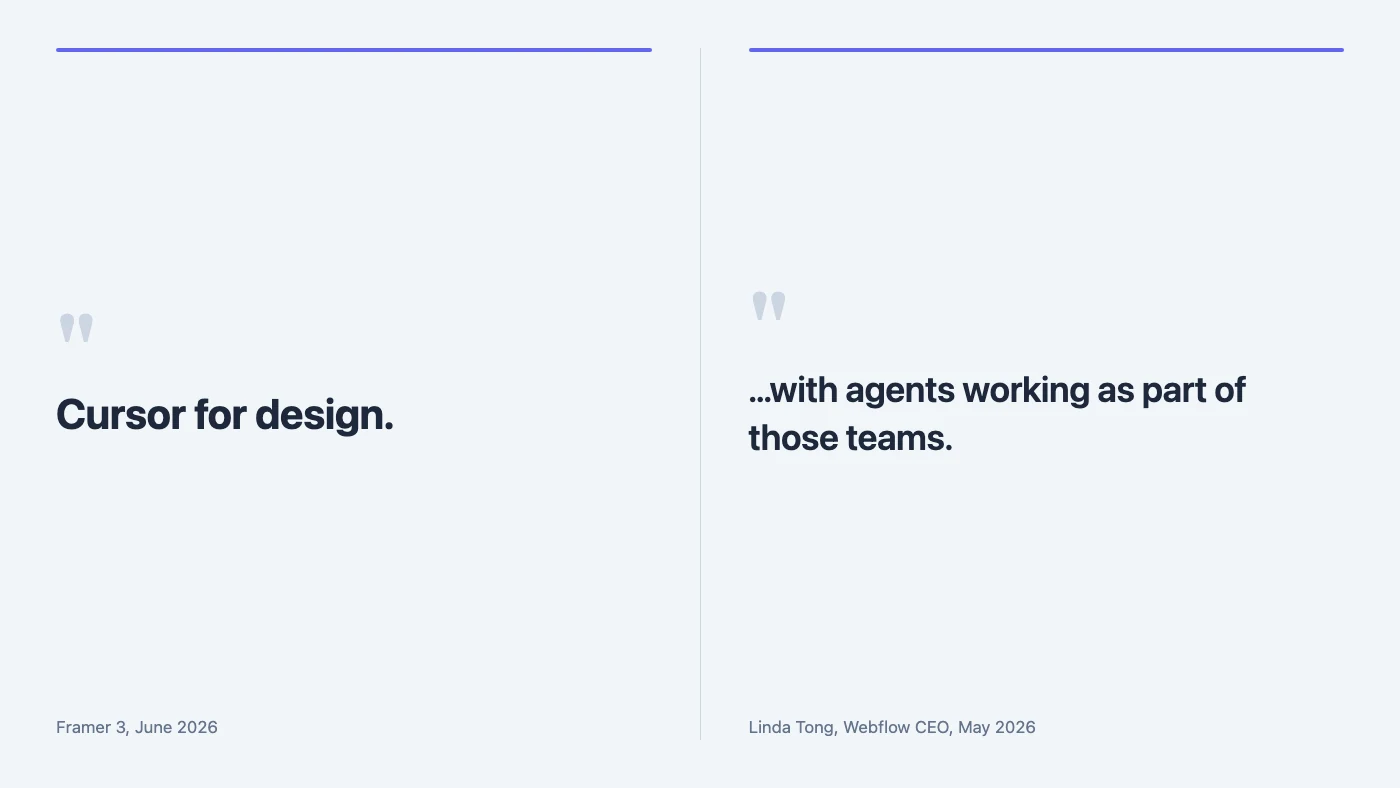
Framer 3 launched on June 16, 2026 with agents working directly inside the canvas, branching for isolated reviews, and connections to Claude Code, Cursor, and Codex. Their shorthand: "Cursor for design."[1] On May 27, Webflow CEO Linda Tong published the company's direction: "one platform where marketing teams can build, optimize, and bring their web experience, marketing systems, and customer journeys together, with agents working as part of those teams."[2]
Both announcements used the label "AI website builder." Both pointed at something structurally different from what that label has meant for the past two years. And they are pointing at different things from each other.
The category is splitting. Generator, workspace, and operator are not marketing tiers. They describe what the tool does with the work after the agent runs. Knowing which tier your current tool occupies changes what you should be asking for next.
TL;DR: "AI website builder" now covers three structurally different tools: a generator (agent runs, output leaves the tool), a workspace (agents and people work inside the same surface, with shared state, branching, and a review layer), and an operator (agents run recurring jobs against the live site between human visits). Most tools in mid-2026 are still generators. A few are crossing into workspace. The tier your tool occupies today changes what you should be asking for next.
The Rename Is Already Done
The "AI website builder" label is doing different work than it was in 2024. Two years ago it meant: prompt in, design out, export to hosting. The agent (or the template engine or the generative layout tool) produced something, and you took it somewhere else.
In mid-2026, both of the most-watched repositionings lead with agents as ongoing collaborators inside a shared environment, not as output machines. Framer's tagline now: "Prompt. Inspect. Edit. Publish. All in one place."[1] Webflow's: agents "working as part of those teams."[2]
Product Hunt's listing for Framer as of June 2026 still reads "AI website builder for professional sites and teams."[3] Framer 3.0 debuted as the #1 product of the day on June 17, #4 of the week.[3] The category tag held. The product description no longer matches what "website builder" used to describe.
This is not a rename where the label changes and the product stays the same. Something real shifted in what site tools can do. But whether a given tool has crossed the structural line is a separate question, and the name does not answer it.
Three Tiers. Not a Spectrum.
The most important thing the rename obscures: "AI website builder" now sits across three structurally different types of tools. They are not a spectrum from basic to advanced. They are different categories.
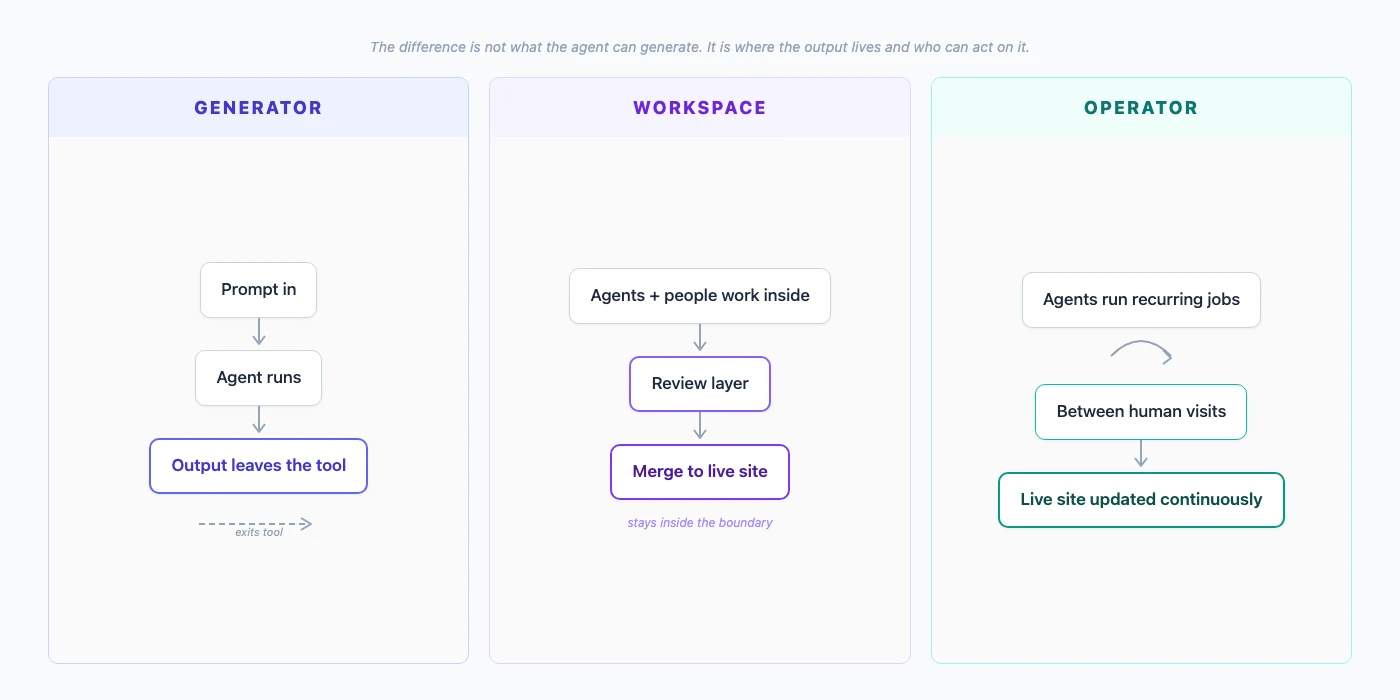
Generator. The agent runs, produces pages or content, and the work product leaves the tool. You export it, deploy it somewhere else, or paste it into your actual site. There is no ongoing relationship between the agent and the live site after the session ends. The tool's job is done when the prompt is done.
Workspace. Agents and people do ongoing site work inside the same tool. The agent makes an edit; a person reviews it; both actors have a shared view of the current state. Branching, review layers, and audit history exist because the work stays inside. The tool is not producing output for somewhere else. It is the operating surface where the site lives and changes happen.
Operator. The site tool becomes a surface where agents run recurring jobs against the live site over time: accessibility audits, broken-link fixes, schema updates, content refreshes. Without waiting for a human to kick off a session. The tool has a scheduler, a durable task model, and the ability to act between human visits.
The test that separates them is not what the agent can generate. It is where the output lives, and who can act on it.
One note on the framework: these three tiers are a lens, not an industry-standard taxonomy. You will not find them in any platform's documentation. What you will find, if you look carefully, is that the tools genuinely in the workspace tier have specific structural requirements (branching, review layers, durable state) and the tools still in the generator tier are adding terminology to describe something that has not changed underneath.
Most AI Website Builders Are Still Generators
"Agents as part of the team" is positioning. The real question is: where does the agent's output live, and what can a reviewer do with it before it goes somewhere?
A generator with a publish button is still a generator. Going from a generated page to a live page is not the same as the agent's work living inside a shared workspace with branching and review. The output travels. The session ends. The next session starts cold.
Framer 3 is the clearest public example of a tool crossing from generator into workspace: agents working inside the canvas, changes landing in an isolated branch for review before reaching production, external agents connected to the same surface.[1] The branching mechanism is the structural tell. A draft toggle answers "is this live?" A branch answers "what changed, compared to what was live before, and do I want it?" Those are different questions, and they require different review surfaces.
The Webflow AEO model (agents surface recommendations, humans accept or reject, changes go live) sits closer to generator-plus-accept-step than to a shared workspace where the agent's work persists in isolation until a reviewer acts on the batch.[2] That is an interpretation, not a product judgment. The accept/reject model is a real design choice with a coherent rationale. It just answers a different structural question than branching does.
Most CMS agents hold cosmetic authority over site content, not real write-access to structure and live state. The approval gate is still the CMS's architecture, not the agent's domain. Understanding that boundary tells you more about what you can actually delegate than any feature list does.
The language both platforms use is accurate. "Agents working as part of the team" does describe the intended experience. The question is whether the tool's architecture supports that experience or whether the team is still exporting output, pasting it somewhere, and calling the session done.
What a Workspace Actually Requires
If you are evaluating a tool and want to know whether it is a workspace or a generator with workspace language, here are four things to ask directly.
Branching. Does the tool offer an isolated environment where an agent's changes can be reviewed against the live site before merging? A draft toggle is not branching. Branching means structural isolation: the agent's edits and the live site are separate states, the review step has comparison not just a flag, and you merge approved work rather than flipping a binary.
Real agent write-authority, scoped. Can an agent write to live content, assets, and structure (not just generate suggestions)? And is that write-authority scoped so the agent cannot publish without a review step? The two things together matter. Write-authority without a review scope is a different risk. A review scope without real write-authority is a generator with extra steps.
Durable state. Does the site's state persist between agent sessions? Can an agent pick up where the last session ended without the human re-explaining context? A stateless generator forgets. A workspace remembers. The practical question: if you ask the agent to "continue what we started last week," does it know what that means?
Multi-actor collaboration. Can a human and an agent work on the same surface, either at the same time or in defined handoffs? If the only workflow is "prompt agent, get output, paste elsewhere," the tool is a generator regardless of the marketing copy.
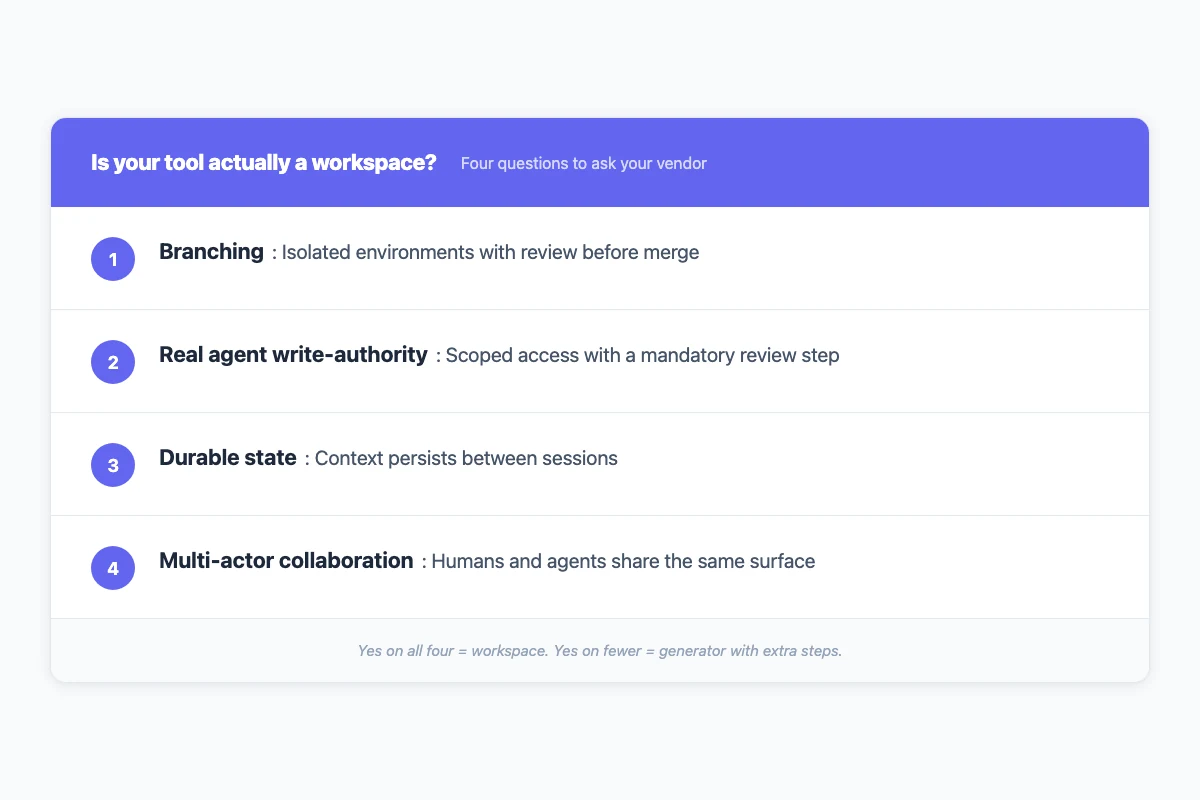
None of these are obscure requirements. You can ask a vendor about each one directly. What you are listening for is whether the answer describes a structural property (branching, versioned states, persistent context) or a feature name that may or may not point at the structural property underneath.
The rename is done. "AI website builder" now sits across generator, workspace, and operator. Most tools are at tier one. Some are reaching tier two. Tier three (agents running recurring jobs between human visits, without a session trigger) is mostly a design direction rather than a shipped product in mid-2026.
The question is not which tier sounds best. It is which tier matches what your team needs to do with the site over time. If your team runs one-off page sprints and exports the result, a good generator is exactly the right tool. If your team manages an ongoing site with multiple people and agents making changes at increasing frequency, the toggle will stop being enough before you expect it to.
Forward this to the person on your team who chose your current website tool.
Common Questions About the Rename
What should an AI website builder be called?
An AI website builder should be called by the structural job it performs: generator when output leaves the tool, workspace when people and agents share persistent site state, and operator when agents can run recurring jobs against the live site over time.
The broad label still helps buyers find the category, but it is no longer precise enough for evaluation. Ask where the output lives, whether review happens before publish, and whether the agent can continue work after the first session ends.
When is "generator" more accurate than "workspace"?
"Generator" is more accurate when the agent produces copy, layout, code, or a page draft that has to be exported, pasted, or deployed somewhere else before it becomes the real site.
"Workspace" is accurate only when the site state persists inside the product and agent edits can be reviewed against that state before they reach the live site. A publish button alone does not make a generator a workspace.
What makes Boomlink different from a generic AI website generator?
Boomlink is not a generator. It is a website platform positioned between AI code generators and WordPress. You start from a complete website template with its own built-in database, a ready-made part system does the functional work, and your AI edits only the wording and layout through MCP in ChatGPT or Claude. Boomlink keeps site versions, forms, analytics, assets, and publishing state, and every plugin and template renders as an embedded widget in one single dashboard.
That does not make Boomlink an autonomous operator for every recurring site task. It does mean the substance is durable plugins and templates, not fragile generated code, and the output does not have to leave the conversation and become someone else's deployment problem before it can go live. The full version of that argument, with the workflow and the limits, is on the AI website builder page.
References
- Framer Blog, "Introducing Framer Agents, Branching, and the new Community" (published 2026-06-16). Framer 3 launched in-canvas agents for page generation, responsive design, SEO metadata, and accessibility audits. Branching ships isolated environments where agent changes land before review and merge into production. External AI workflow connections include Claude Code, Cursor, and Codex. Tagline: "Prompt. Inspect. Edit. Publish. All in one place." Positioning framing: "Cursor for design." Vendor capability claims; not independently benchmarked. https://www.framer.com/blog/framer-3/
- Webflow Blog, "Evolving Webflow for the agentic web" by Linda Tong, CEO (published 2026-05-27). Webflow reframes as "the agentic web marketing platform." Direct quote: "one platform where marketing teams can build, optimize, and bring their web experience, marketing systems, and customer journeys together, with agents working as part of those teams." Vendor positioning; "agents as part of the team" is the stated vision, not an independently verified product capability description. https://webflow.com/blog/evolving-webflow-for-the-agentic-web
- Product Hunt, Framer product page (captured 2026-06-26). Framer listed under "Website builders," "No-code Platforms," "Content Management Systems," and "No-Code Website Builder." Current tagline: "AI website builder for professional sites and teams." Framer 3.0 debuted as #1 product of the day on 2026-06-17, #4 of the week. Third-party market signal; listing reflects vendor-submitted category tags, not an independent category assessment. https://www.producthunt.com/products/framer